How Valeria Foglar-Deinhardstein turned a restless drive to create into a portfolio of ventures spanning animal health, women’s wellbeing, and the next generation of Austrian founders
The first word that comes to mind when you sit across from Valeria Foglar-Deinhardstein is liveliness. She speaks about the work of building companies the way other people talk about a passion that has finally clicked into place — quickly, vividly, leaning forward. It is the energy of someone who has stopped asking whether she is on the right path and started asking how far that path can go.
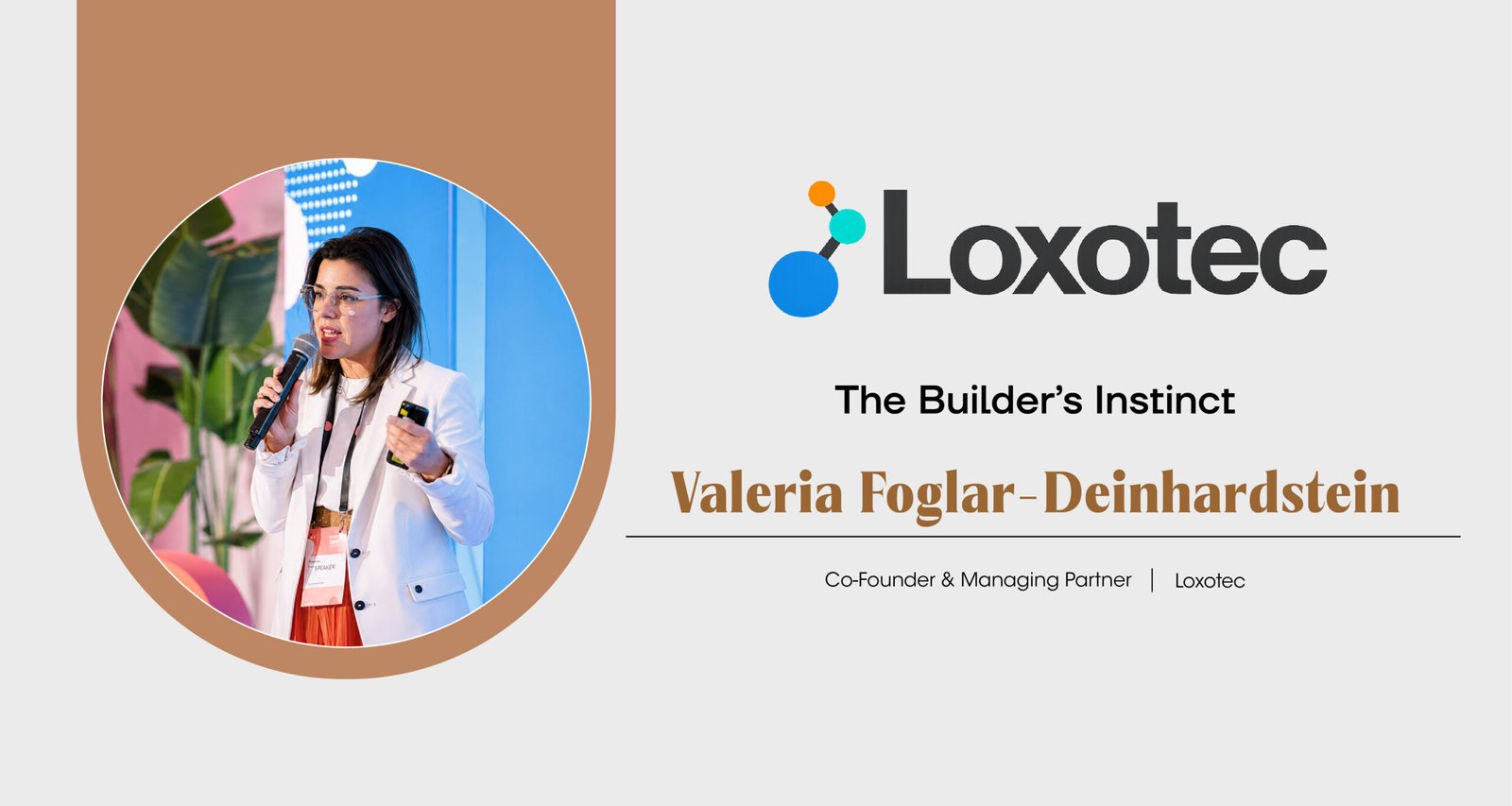
That conviction did not arrive early. Foglar-Deinhardstein came to entrepreneurship by way of the public sector, the European Parliament, and a telecommunications corporation — a CV that reads like a deliberate tour through the institutions that shape modern Europe. Today she is Co-Founder and Managing Partner of Loxotec, an Austrian company in animal health and professional disinfection; the founder of Viedonna, a women’s health center; a delegate to the Austrian Federal Economic Chamber; and the founder and president of three associations of her own. The throughline is not an industry. It is a temperament.
“There is nothing that gives as much energy and satisfaction as building a business.”
The Long Way Round
Foglar-Deinhardstein grew up in an entrepreneurial family of Italian heritage — the Barbaro family, long known in Vienna for its Italian restaurants — surrounded by the rhythms of a business run at home. She went on to study at Bocconi University in Milan, one of Europe’s most prestigious business schools. By the logic of inheritance, the obvious move would have been to join the family firm, as her brothers did. She chose, instead, a series of detours — and for a long time told herself that her ambition could be spent elsewhere.
“I always had the urge to create something,” she recalls, “but I thought I could live out that energy more fully in other areas. The idea was to somehow save the world — to do something great.” That instinct carried her into public service, then to the European Parliament, and on to A1 Telekom Austria, where she worked at the intersection of innovation, internationalization, and marketing. Each role taught her how large organizations move: how decisions are made, how influence is built, and — crucially — how slowly a good idea can travel through a system designed for caution.
It was a productive frustration. “In all the structures I worked in, I always had to lobby laboriously to get an idea realized,” she says. The lesson stuck, even if the satisfaction did not. Somewhere in those years she began to suspect that the thing she wanted most — to make something of her own — was not waiting for her inside someone else’s organization.
Finding the Work That Fit
The turn to entrepreneurship came through partnership rather than grand strategy. Foglar-Deinhardstein joined Loxotec alongside a close friend, after the two realized how well they worked together and went looking for a way to do more of it. “We noticed that we collaborate really well, and we were looking for an opportunity to intensify that,” she says. At Loxotec she took charge of sales and marketing — the outward-facing, relationship-driven work where her strengths are most at home.
Loxotec sits in a deliberately practical corner of the market. The company develops products for animal health and tailored solutions for water, surface, and air disinfection for business customers. Its B2B veterinary brand, Sanocyn, addresses the unglamorous but universal problems of animal care — cleaning and treating wounds, soothing skin irritations, neutralizing odors, calming inflammation, and easing the aftermath of insect bites. It is the kind of product line that wins not on hype but on whether it works the second and third time a veterinarian reaches for it.
On that test, the company has traveled remarkably far. Sanocyn has established a presence across roughly twenty countries — from Germany, Switzerland, and Austria to Romania, Finland, Spain, Bulgaria, Hong Kong, and, through its Sanocyn Forte line, the United Arab Emirates. For a company of its size, that footprint is the real headline: a Vienna-based team selling a credibility-dependent health product into markets with very different regulatory regimes, distribution norms, and languages.
The next chapter is a familiar but high-stakes one for any founder who has proven a brand business-to-business: bringing it directly to consumers. That move now has a name — Loxovet, the company’s consumer-facing line, built on a deceptively simple promise: veterinary-grade quality for the home. The range — an “SOS gel,” an eye cleaner, an ear cleaner, and a dental cleaner for dogs and cats — is built on stabilized hypochlorous acid (HOCl), a substance the body’s own immune system produces. The products are antibacterial and suitable for wound care, antibiotic- and alcohol-free, and were developed together with veterinarians in Austria and Germany, with an explicit goal of reducing antibiotic use in pets and the resistance that follows it. “Our vision is clear,” Foglar-Deinhardstein says. “We want to make animal health simpler, safer, and more sustainable — for veterinarians and for pet owners alike.”
Having earned its reputation among veterinary professionals, Loxotec is now translating that clinical trust into the language of the household, where the buyer is no longer a clinic but a pet owner who simply wants their animal to feel better. Loxovet already reaches customers through online retail, pet specialists, and dog grooming salons; the clear ambition is the shelves of bricks-and-mortar retail across Europe — a move that rewards exactly the marketing-and-positioning instincts Foglar-Deinhardstein has spent a career sharpening.
Two Minutes, Two Million
In early 2026, Foglar-Deinhardstein took Loxovet to the most public test an Austrian founder can face: the investor television show 2 Minuten 2 Millionen (Puls 4), the country’s answer to Shark Tank. She pitched — with dog Cookie at her side — and walked away with not one but two offers on the table. Alexander Schütz offered €250,000 for 25.1 percent of the company; Katharina Schneider offered €200,000 for 20 percent. Loxotec ultimately accepted Schneider’s offer earmarking the capital for European retail expansion, further veterinary studies, and new product development. It was a vivid, on-camera vindication of a quieter conviction she had held for years: that the work she believed in could stand up to scrutiny once she stopped asking permission to pursue it.
“Now, for the first time, I feel truly free to realize my potential.”
Ask her what she loves most about the work, and the answer is not the deal or the growth chart — though closing a deal, she admits, feels “really cool.” It is autonomy. “In all the other structures I was part of, I had to fight to push an idea through,” she says. “Now I feel free to fully use my potential, and to work on the things I believe are good — for others, for society, and for me.” After years of moving ideas through institutions, she had finally found a place where the distance between conviction and action was short enough to close herself.
A Second Conviction: Viedonna
Most founders spend their early years guarding against distraction. Foglar-Deinhardstein runs the opposite experiment, deliberately widening her aperture. In parallel with Loxotec she founded Viedonna, an inter- and multidisciplinary women’s health center conceived for the German-speaking DACH region — a space designed to treat women’s health as the connected, whole-person subject it is, rather than a set of specialties that rarely speak to one another.
Viedonna is, in its way, the most personal expression of the philosophy she repeats most often: that the future belongs to people who can combine skills rather than hoard them. “In today’s world you simply need cooperation and the integration of different skills,” she says. “You shouldn’t be afraid to work with other people.” It is a conviction that doubles as an operating model — one woman assembling specialists, disciplines, and partners around a problem she believes has been underserved for too long.
There is a deliberate logic to building Viedonna and Loxotec in parallel rather than in sequence. Both businesses turn on the same scarce commodity — trust in matters of health — and both reward a founder who can translate clinical credibility into something an ordinary buyer understands and acts on. The animal-health work and the women’s-health work are, in that sense, two laboratories for the same question: how do you take expertise that lives inside specialists and institutions, and deliver it to the people who actually need it, without losing what made it credible in the first place? It is a question Foglar-Deinhardstein seems temperamentally suited to keep asking.
Learning the Hard Way
Foglar-Deinhardstein is unusually candid about the cost of all this. She describes her own trajectory, without self-pity, as “learning the hard way.” The phrase is earned. She and her team have already lived through the dissolution of a business partnership that could only be settled in court — the kind of episode that quietly ends many young companies and hardens the founders who survive it.
She is equally frank about capital. “Sometimes I feel like other people have the know-how for how to get to money relatively easily,” she says. “I’d like to have that too.” It is a rare admission from someone in a leadership profile, and a useful one: the constraint she names — limited financial resources standing between vision and execution — is the single most common brake on ambitious founders, and one too often hidden behind the gloss of success stories. Hers is not hidden. “But fundamentally,” she adds, returning to the refrain that anchors everything else, “I’m living my dream as an entrepreneur right now.”
There is, she notes as an aside, an extra weight on that particular scale — one the data backs up. Raising money is simply harder as a woman; female founders still capture a thin slice of venture funding, and the room she pitches into is rarely built with her in mind. She does not dwell on it or make it her headline. But it lends a sharper edge to a televised deal closed on her own terms, and a quieter purpose to Erfolgsschwestern, the network she founded for exactly the women working to even those odds.
“In today’s world you need cooperation. Don’t be afraid to work with other people.”
Beyond the Balance Sheet
Foglar-Deinhardstein’s sense of contribution does not stop at her own ventures — and the list of where she gives her time is long. She serves as a delegate to the Austrian Federal Economic Chamber (Wirtschaftskammer), representing business interests within the institution that organizes Austria’s economy, and sits on the programme board of the Austrian Health Economy Congress (Österreichischer Gesundheitswirtschaftskongress), helping shape the national conversation on where health and business meet — a natural extension of her work with Viedonna and Loxotec. She stays active in local politics, having served as a district councilor, and stood as a candidate in the 2019 and 2024 European elections, carrying her institutional fluency back into public life. And she has held volunteer leadership at the international level, including as a chairperson of the NGO Committee on the Family at the United Nations in Vienna.
Most tellingly, she does to civic life what she does to business: she founds things. Foglar-Deinhardstein is the founder and president of three associations — the Brussels Alumni Club, which keeps alive the European networks her career was built in; the Gran Ballo Italiano, and Erfolgsschwestern (“Sisters of Success”), a network for women advancing in their careers and ventures. In each case the pattern is the same as in her companies: she does not wait for a platform to exist, she builds one.
The Gran Ballo Italiano is perhaps the purest expression of that instinct — and of her Italian heart. Co-founded with her brother, the restaurateur Luigi Barbaro, the ball celebrated its premiere on 29 May 2026 in the festive surroundings of Vienna’s Palais Niederösterreich, drawing guests from business, culture, diplomacy, and society. Under the motto “La Dolce Vita a Vienna,” it fused Viennese ball tradition with Italian gioia di vivere: the palace courtyard was transformed into a mercato complete with pizza oven and pasta station, the evening opening in the Landtagssaal with arias and dance under an artistic direction of its own — a deliberately less formal twist on the classic ball. The ambition is openly stated: to establish the Gran Ballo as a fixed entry in Vienna’s storied ball season. It is, in miniature, the same move she makes everywhere — spotting something that should exist, and willing it into being.
Taken together, these roles describe a leader who treats civic engagement not as a side project but as part of the same impulse that drives her companies. The young woman who once wanted to “save the world” has not abandoned that ambition; she has simply learned to pursue it through many smaller, concrete acts of building — a product, a clinic, a brand, a network, a sisterhood, a ballroom full of her community.
Focus, Forged
The defining personal turn of her adult life, she says, was becoming a mother. She had her two children at 33 — “the biggest impact ever in my life.” She is honest about the trade. “I lost a bit of my lightness,” she reflects. But the same disruption delivered something she now counts as a gift. “It forced me to focus more. And that did me good.”
She allows herself the occasional counterfactual — what if she had started a family at 25, or grown up faster, or moved further by now? — before waving it away with a laugh. “That’s just how my path has been so far. The journey is also the destination.” It is the mindset of someone who has made peace with the non-linear shape of her own career, and who has stopped treating the detours as time lost. Even rest gets reframed in her favor: “I always tell myself that sleep is leisure time. And when I put the kids to bed and fall asleep next to them, I don’t have to be annoyed — I can be glad about it.”
It is a useful piece of reframing for any leader trying to sustain output over decades. Foglar-Deinhardstein does not treat the demands of family and the demands of building as a zero-sum contest to be won, but as constraints that, properly handled, sharpen each other. Limited time forces sharper priorities. Sharper priorities make the time that remains more productive. She is not romantic about the arithmetic — the lost lightness is real — but she refuses to file motherhood under sacrifice. In her telling, it is the discipline that made the rest of the work possible.
The Portfolio Ambition
If there is a single statement that captures where Foglar-Deinhardstein is headed, it is this: “I’d like to found many more companies and look at lots of different industries.” She is, by instinct, a serial builder — more interested in the act of creation, and in what each new sector can teach her, than in settling permanently into any one of them. Loxotec and Viedonna are not endpoints. They are early entries in a portfolio she fully intends to keep extending.
That ambition comes with clear eyes about what it requires. She would welcome more capital, more runway, more of the financial fluency she watches others wield. But the scarce resource in entrepreneurship was never really money; it was the willingness to begin, repeatedly, without a guarantee. On that count Foglar-Deinhardstein is well supplied. She spent the first stretch of her career learning how the world’s institutions say no. She has spent the second proving how much one person can build once she stops asking permission.
“The journey is the destination,” she says again — and from her, it does not sound like a consolation. It sounds like a strategy.