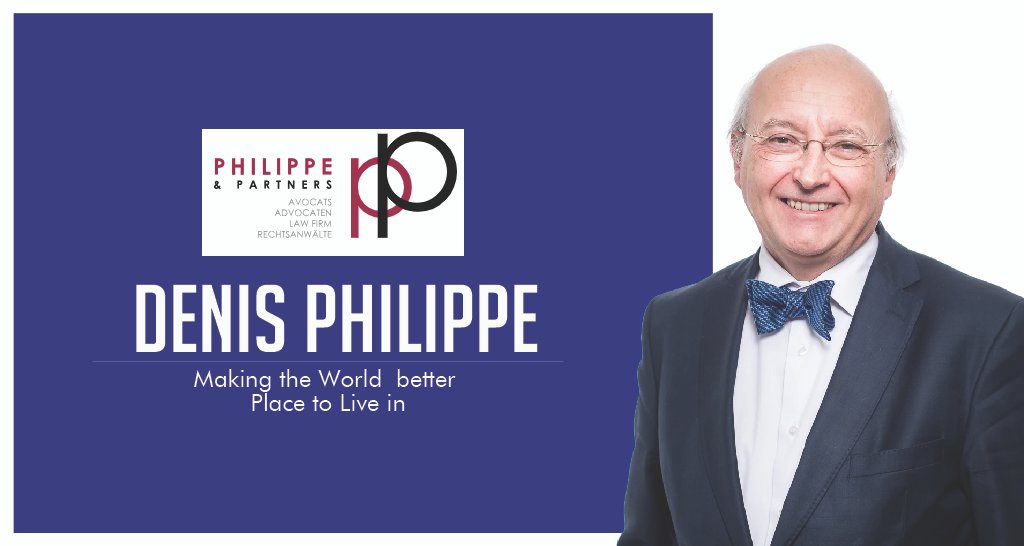
Meet Denis Philippe, the founding partner at Philippe & Partners (P&P), a law firm with strong presence in Belgium and Luxembourg, specializing in corporate, insurance, energy, and dispute resolution.
With over four decades in the legal profession, Denis carries the calm confidence of someone who has seen the law evolve, reshape itself, and expand in ways few could have predicted. Yet beneath his achievements lies a simple, enduring belief: that law has the power to hold society together.
Denis’s journey began with a single realization. “When you study law, you understand how society functions,” he says. For him, the appeal of the legal field was never abstract, rather it was a way to understand everyday life. For him, contract law, commercial law, administrative law revealed another layer of the societal engine. Not being naturally drawn to mathematics, the world of law offered Denis a different path: one that satisfied his curiosity about structure, systems, and order.
At the Center of Energy’s Global Transformation
Among several other chapters of Denis’s career, none have shown such sweeping evolution as energy law. When he began, the world was stable, with Nuclear power being dominant and unquestioned.
Then Fukushima happened.
Almost overnight, political sentiment shifted. Nuclear energy came under strict scrutiny. Green movements gained momentum. Oil and gas, also found criticism over carbon emissions. Suddenly, the world started looking for alternatives: hydrogen, bioenergy, renewables, which eventually led to the modern revival of nuclear innovation.
Today, as Vice Chairman of the International Nuclear Law Association, Denis is witnessing this resurgence firsthand. Now with the revival of the UK’s nuclear law, companies like Rolls Royce have launched small modular reactors, which is just one sign of what Denis calls “nuclear law rising to the stars of the future.” In his view, the wave of regulation and innovation surrounding energy law marks it as one of the most dynamic legal fields of the coming decades.
The Answer to Slow Courts
Denis believes that if energy law represents a technical transformation, arbitration represents a cultural one. He describes arbitration as a modern, private, and trusted way to resolve disputes in a world where national courts often move too slowly for the pace of business.
“People prefer to work with people they trust,” he says, reflecting on his many years as chairman of arbitration tribunals in Belgium, Luxembourg, and France. The process, he explains, allows parties to find clarity and resolution without the burdens of traditional litigation.
The race to regulate the Financial Sector
Denis feels financial, and banking law has undergone a massive revolution that no one could have predicted at the start of his career. Thanks to Crypto, digital fraud, and the constant reinvention of financial systems, this field has become one of the most heavily regulated and fast-moving areas of modern law.
He has written extensively on digital currencies and blockchain and has participated in the European Law Institute’s work to harmonize blockchain frameworks across the continent. His involvement in drafting the’s digital rights principles reflects his conviction that the future of law demands both innovation and caution.
Shaping the European Harmonization Efforts
In addition to his legal practice, Denis has spent over fifteen years shaping Europe’s harmonization efforts as a member of the European Law Institute, including five years on its Executive Committee.
Over that time, he has seen Europe evolve in ways that many citizens rarely notice, despite these changes influencing their daily lives. Harmonized consumer laws, unified technical regulations, and clearer cross-border frameworks, he says, are among the European Union’s quiet but significant achievements. Yet Denis is equally candid about the challenges. Europe remains, at its core, a confederation, one where national identities carry great weight and major decisions require broad consensus, which often slows progress.
“We have to respect each other,” he says. “But the pace of development is not the same as in a federal state like the United States.”
Advice for Lawyers
When asked what young lawyers should prioritize, Denis doesn’t hesitate. “Good judgment,” he says, “comes first.” He firmly believes, thinking clearly and soundly is the backbone of good lawyering. Rigor follows closely behind. And above all, honesty, as without it, legal arguments collapse.
Additionally, Denis also places enormous value on dialogue. He believes, mediation, negotiation, and straightforward communication can resolve many disputes long before they ever reach a courtroom. “When people speak to each other,” he says, “they avoid unnecessary costs and find solutions faster.”
A Long-lasting Legacy
After so many years, Denis hopes to be remembered for his contributions to the areas of law he has helped shape, including energy, arbitration, ( he is often appointed as chairman or coarbitrator of the arbitral tribunal) and digital law, and for the international perspective he has championed throughout his career. He wrote his thesis on the doctrine of unforeseen circumstances and he is happy that this doctrine has been recognised by the Parliament in st the new civil Code entered into force on the 1 of January 2023He believes that working internationally fosters tolerance and exposes lawyers to ideas that elevate their own legal systems.
But above all, Denis wants the next generation of lawyers to value humanism.
“A law firm must be built on humanistic values,” he says. “Respect for others is essential.”
Picture of the Future
As the conversation draws to a close, Denis offers one final reflection. The law is far from finished evolving, and neither are the lawyers who practice it.
“The law and the lawyer still have a big life ahead. We must continue moving forward for the next generation.”
It is a fitting thought from a man whose career has shaped not only laws and regulations but the very principles guiding Europe’s legal evolution. After decades at the forefront of energy transformation, arbitration, and European harmonization, he remains focused on the future, clear-eyed, committed, and deeply human at his core.